

Teach Boolean logic at KS3 with recommendation systems (free lesson + resources)
Teach Boolean logic at KS3 with recommendation systems (free lesson + resources)
Boolean logic can be one of those KS3 topics that gets taught because its on the list rather than because it feels exciting.
It often starts with logic gate symbols and truth tables, then we hope pupils will magically see why any of it matters.
But there’s a much more natural way to teach it that give real meaning and context to the pupils.
Recommendation systems are already part of pupil’s everyday lives. They understand:
“Suggested for you”,
“Because you watched” and
“You might also like”.
That makes them a brilliant context for teaching AND, OR and NOT in a way that feels modern, relevant and meaningful.
In this post I’m sharing a free lesson from my Introduction to Boolean logic unit plus a walkthrough so you can run it confidently.
Why recommendation systems work so well for Boolean logic
Boolean logic is about rules and recommendation systems are rules in action.
When pupils can see that a platform is making decisions based on conditions, the logic gates stop being random shapes and start being a language for decision-making.
This approach helps because:
It starts with a familiar context so pupils are not learning the concept and the context at the same time
It makes logic feel like a real computing idea not a worksheet exercise they are learning just because it is part of the computing curriculum
It naturally leads to discussion about data including what happens when data is inaccurate or misused
It supports mixed ability classes because the context is accessible but the reasoning can be stretched
You still teach AND, OR and NOT. You still teach logic circuits. You just do it in a way that pupils can connect to.
Lesson overview: recommendation rules (60 minutes)
Learning objective: I can use AND, OR and NOT gates to test a recommendation rule and decide which games should be recommended.
Previous knowledge: pupils should already know what data is, what a condition is and how to read a table.
1) Recommendation systems first (about 18 minutes)
Use the slides to model simple rules using a small game table.
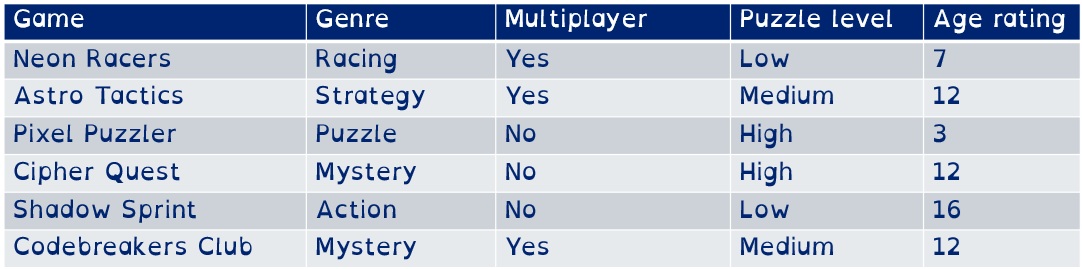
You can ask questions like:
Which game is mystery AND has a high puzzle level?
Which game is multiplayer AND age rating 12?
Which games are multiplayer OR have a high puzzle level?
Which games are NOT mystery games?
This is where pupils start thinking in conditions without needing any symbols yet.
You can then explain that recommendation rules can be based on data such as watch history, likes, searches, time spent playing that game, location or age.
The system looks for patterns, then uses those patterns to decide what to show.
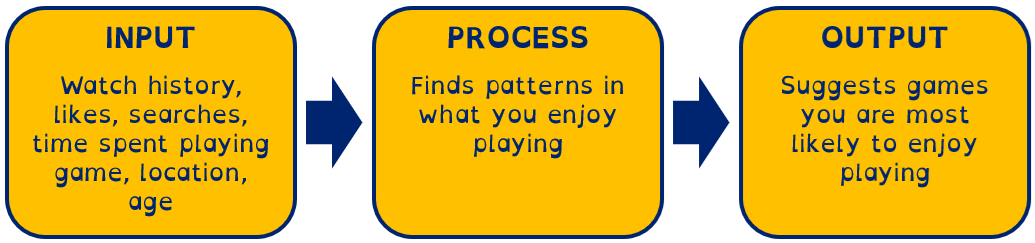
Then you can move into a short group discussion.
In groups of 3 or 4, pupils choose a platform that recommends things (music, shopping, video, games) and decide:
three bits of data the platform could use
one risk if the data is misused
This is a brilliant moment to bring in digital literacy without derailing the lesson.
2) Teach logic gates (about 7 minutes)
Now you introduce the symbols.
Because pupils already understand the rules, the gates become a way to represent the rules clearly.

Logic gate explanation:
AND is only true when both inputs are true
OR is true when at least one input is true
NOT flips the input
3) Logic circuits and the worksheet (about 20 minutes)
Explain that a logic circuit combines logic gates to represent a longer rule. Each gate does one small decision, then the output can feed into the next gate to build a bigger decision.
Model one circuit together.
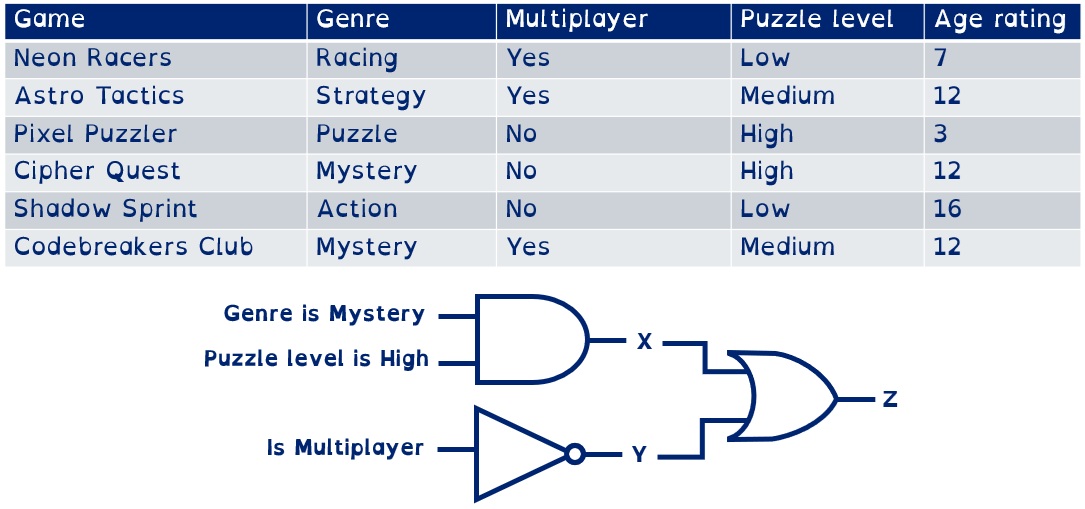
Example from the lesson:
If the genre is Mystery and the puzzle level is High or if it is not a Multiplayer game.
The games that would be recommended in this instance would be Cipher Quest, Pixel Puzzler and Shadow Sprint.
Then pupils complete the worksheet in pairs.
They will:
write each recommendation rule in plain English
apply the rule to the game table
list the recommended games
4) Peer mark and whole class feedback (5 minutes)
Pupils swap worksheets and mark.
This is useful because it surfaces the common misconception quickly.
Most errors come from:
mixing up AND and OR
forgetting that NOT flips the condition
Not breaking down the answers for each gate before trying to work out the entire logic circuit
Free download of the lesson resources
You can download all the Lesson 1 resources here:
PowerPoint
Lesson plan
Worksheet
Download the lesson resources here: Free lesson
Want the full 3-lesson unit?
If you’d like to teach this as a complete mini unit, the full Introduction to Boolean logic pack includes three lessons that build confidence step-by-step.
Lesson 1 - Recommendation rules (this lesson)
Lesson 2 - Design logic circuits (filtering in Excel using AND, OR and NOT)
Lesson 3 - Build a recommendation system (writing If statements in Excel using AND, OR and NOT)
View the complete three-lesson Boolean logic unit here: Boolean Logic Unit
A final note
You don’t have to teach Boolean logic as a dry, isolated topic. When you give pupils a context that feels real, you get better discussions, better reasoning and far less of the “Why are we doing this?” pushback.
If you try this lesson, I’d love to hear how it goes.

